


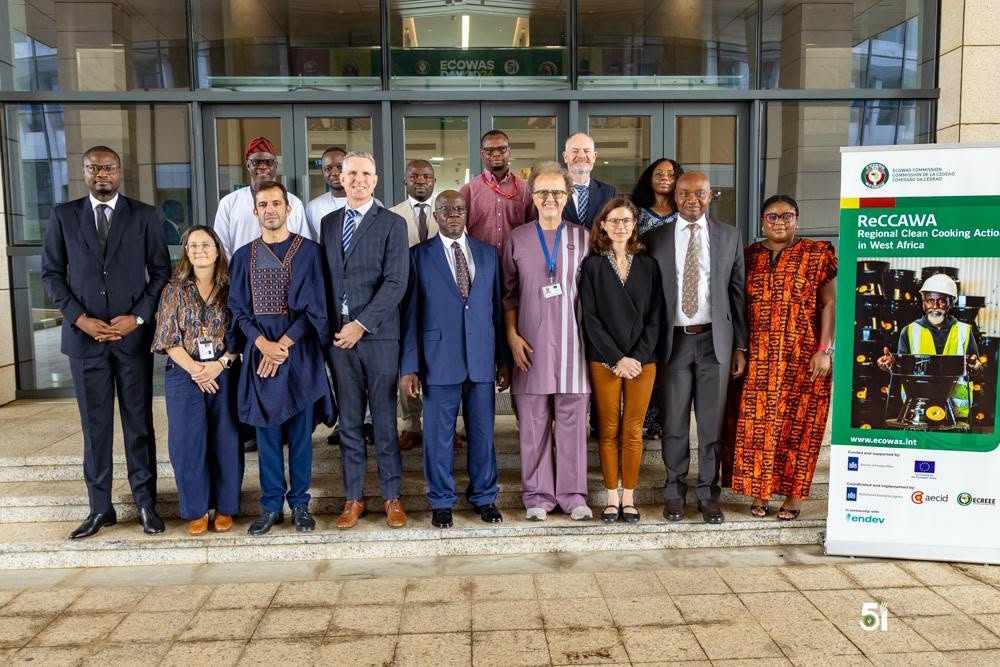
The Steering Committee of the Regional Clean Cooking Action in West Africa (ReCCAWA) held its second meeting at the ECOWAS New Headquarters in Abuja on 18 September 2026, under the chairmanship of Mr. Amin Amidu Sulemani, ECOWAS Commissioner for Infrastructure, Energy, and Digitalization.
Financed with 17 million EUR by the European Union and the Netherlands Ministry of Foreign Affairs, ReCCAWA aims to give 750.000 people in West Africa access to clean cooking solutions and to avoid 100.000 tonnes of CO2 equivalent per year over the period 2025 to 2028. The Action is steered by the ECOWAS Commission and implemented jointly by ECREEE, the Spanish Agency for International Development Cooperation (AECID) and the Netherlands Enterprise Agency (RVO).
Opening the meeting, the commissioner highlighted the continued reliance of many households across the region on firewood and charcoal for cooking and the resulting impacts on the health of women and children, forests, and the climate. He described ReCCAWA as an ambitious and transformative response to these challenges. Mr. Massimo De Luca, Head of Partnership at the Delegation of the European Union to Nigeria and ECOWAS, highlighted the programme’s alignment with the Global Gateway strategy and its emphasis on promoting the local production of clean cooking solutions. Mr. Ronald Sonnemans, Deputy Head of Mission at the Embassy of the Kingdom of the Netherlands, underscored the region’s persistent clean cooking access gap and called for the preparatory work undertaken to translate into tangible implementation and results.
During the Steering Committee meeting, ECREEE, AECID and RVO presented progress achieved since the first meeting in 2025 and outlined the key results expected by the end of the year. ECREEE was represented by its Executive Director, Mr Gibson Obasi, in his capacity as a member of the Steering Committee.
The Steering Committee adopted the 2025 Annual Report and the revised 2026 Annual Work Plan, together with updated governance arrangements that provide for the participation of observers from ReCCAWA National Focal Points and EU Delegations across the region. The Committee also agreed on measures to strengthen the programme’s resources and partnerships and endorsed the preparation of a visibility event, with a proposal to be presented to members in the coming weeks.